3+30+300 analysis
A model for healthier and greener cities
Research clearly shows that trees in urban environments have positive effects on human health, well-being and climate resilience. To translate this knowledge into concrete urban development, Professor Cecil Konijnendijk has developed the 3+30+300 rule, an evidence-based method with clear objectives:
-
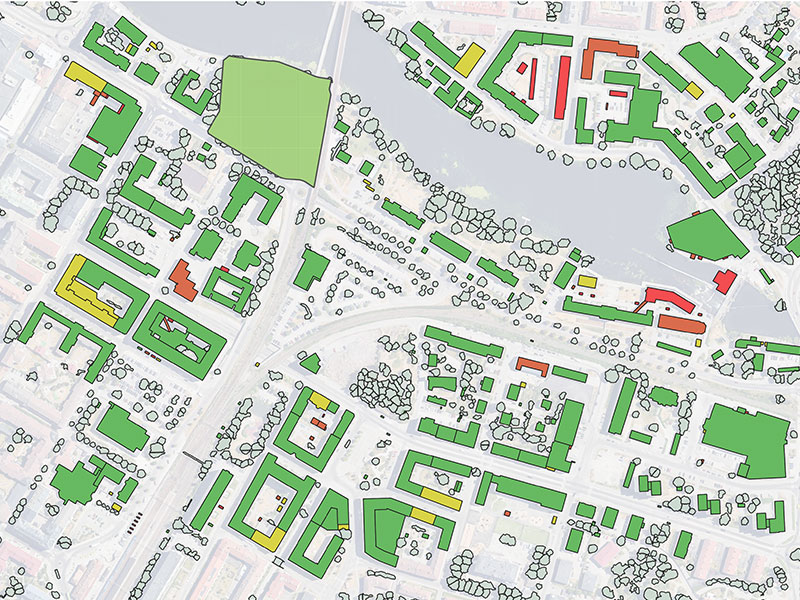
3 trees should be visible from each residential window
-
30% tree canopy cover in each residential area
-
300 m to the nearest park or green area
Working strategically with 3+30+300 is a powerful tool to make cities greener, healthier and more sustainable.
What we offer
We help municipalities and real estate developers to implement the 3+30+300 principle in practice, from baseline analysis to follow-up and target setting.
3 - We can help you create a strategy for where trees should be planted and, using GIS analysis, find out the distance between trees and buildings.
30 - We can measure the tree canopy cover in your city. The measurements are done at different scales such as overall for the whole city, divided into different areas or as a detailed canopy cover map.
300 - We can provide analysis on how many people live within 300 meters of a green space. We can also help you develop methods to measure green space quality, which is often not included in national surveys.
Contact us if you want to know more about 3+30+300 analysis!
We are here to answer your questions. Feel free to contact one of us and we will guide you in the right direction.


This project was co-funded by the European Union.
This funding has enabled the development of our 3+30+300 analyses, which strengthen the knowledge base and provide decision support for sustainable urban development.